1997 Grand Palais LILLE (FR)
1997 Grand Palais LILLE (FR)
1997 Grand Palais LILLE (FR)
What is Time ?
Is it an objective reality, a necessary illusion, or a living construction, always transforming itself ? Since ancient times, time has been measured, cut out, and mastered. Yet, as soon as it is no longer counted, it disappears. In quantum physics, Time ceases to be absolute: it becomes relative, uncertain, sometimes reversible, sometimes suspended. Long considered as a stable and universal datum, Time is no longer obvious today. With relativity, it expands and contracts according to movement and speed. It loses its continuous character: is it a series of discontinuous moments, ready to happen ?
Perhaps Time is not moving forward. Maybe it unfolds, bends, plays again at every moment.
It is no longer a flow, a continuous line, but a relationship between movement, space, and the observer at moment T. On the other hand, the existence of ‘alternative time lines’ seems to be a reality …
Events no longer exist independently of observation. Movement is born from the relationship between the body, space, and gaze.
In the hall of the Grand Palais de Lille, a place of passage between outside and inside, between expectation and appearance, the works of this exhibition act as thresholds, portals. They remind us that the Time of the show is not that of the clock, but that of presence. A fragmented time, vibrant, unpredictable, which does not flow, but arises. Maybe Time, like the stage, is not a fixed frame, but a shared experience, at each glance, at each presence. As in quantum physics, nothing happens until the interaction takes place. And perhaps dancing on an empty dial is to affirm that the instant, as brief as it may be, already contains eternity…
The clock has lost its hands, emptied of its primary function. It no longer controls, it questions and no longer measures a regular flow. It becomes a framework, a field of experience and does not indicate any precise time, but suggests a series of states, discrete moments, similar to quantum jumps. On his old bare dial, a little metal man dances. Mechanical and poetic figure at the same time, he embodies a fundamental tension: that between the rigor of measured Time and the intimate experience of lived time. This dance marks neither the hour nor the duration. It opens a space of suspension, an interval where Time becomes sensitive, almost fragile. What if, at the heart of this incessant movement, dancing was a way to resist him or to live in it fully ? the dancer evokes a particle in motion: his position is never quite fixed, his gesture only makes sense in the gaze of the one who observes it.
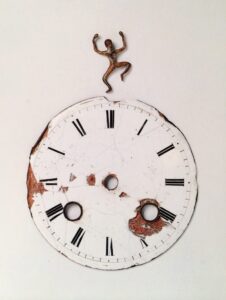
Mixed technical collage – Untitled