Healing Powers of Colors and Forms
Christian Havet, Maro Tsotalou-Rothenhöfer, Georg Rall
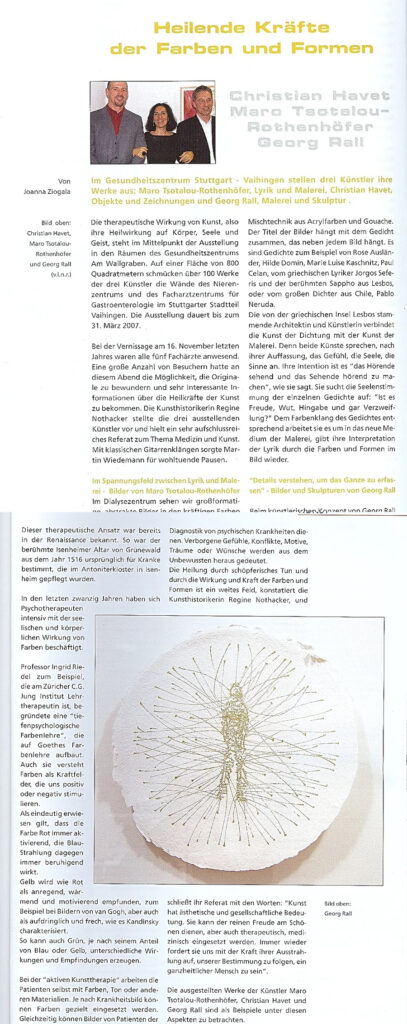
Three artists are exhibiting their works at the Stuttgart-Vaihingen Health Center: Maro Tsotalou-Rothenhöfer, poetry and painting; Christian Havet, objects and drawings; and Georg Rall, painting and sculpture.
The therapeutic effect of art, i.e., its healing effect on body, soul, and spirit, is the focus of the exhibition in the rooms of the Health Center on Wallgraben. Spanning an area of 800 square meters, over 100 works by the three artists adorn the walls of the Kidney Center and the Specialist Center for Gastroenterology in the Stuttgart district of Vaihingen. The exhibition runs until March 31, 2007.
All five specialists were present at the opening on November 16 of last year. A large number of visitors had the opportunity that evening to admire the originals and gain very interesting information about the healing powers of art. Art historian Regine Nothacker introduced the three exhibiting artists and gave a very insightful presentation on the topic of medicine and art. Martin Wiedemann provided a soothing break with classical guitar music.
In the tension between poetry and painting. We see large-format paintings by Maro Tsotalou-Rothenhöfer in the dialysis center.
Mixed media of acrylic paints and gouache. The titles of the paintings are related to the poems hanging next to each one. These include poems by Rose Ausländer, Hilde Domin, Marie Luise Kaschnitzj, Paul Celan, the Greek poet Jorges Seferis, the famous Sappho from Lesbos, and the great Chilean poet Pablo Neruda. The architect and artist, originally from the Greek island of Lesbos, combines the art of poetry with the art of painting. For, in her view, both art forms address the emotions, the soul, and the senses. Her intention is « to make the hearing see and the seeing hear, » as she puts it. She explores the emotional mood of each poem: « Is it joy, anger, devotion, or even despair? » In keeping with the poem’s color scheme, she reworks it into the new medium of painting, conveying her interpretation of the poetry through the colors and forms in the image.
« Understanding details to grasp the whole » – Paintings and sculptures by Georg Rall
At the Georg Rall Artistic Concert
This therapeutic approach was already known in the Renaissance. Grünewald’s famous Isenheim Altarpiece from 1516, for example, was originally intended for the sick who were cared for at the Antoniter Monastery in Innisenheim.
Over the past twenty years, psychotherapists have intensively studied the mental and physical effects of colors.
Professor Ingrid Riedel, for example, a teaching therapist at the C.G. Jung Institute in Zurich, founded a « depth psychological theory of color » based on Goethe’s theory of color. She, too, understands colors as force fields that stimulate us positively or negatively. It is clearly proven that the color red always has an activating effect, while blue radiation always has a calming effect. Like red, yellow is perceived as stimulating, warming, and motivating, for example, in paintings by van Gogh, but also as intrusive and bold, as characterized by Kandinsky. Green, too, can create different effects and sensations depending on its proportion of blue or yellow.
In « active art therapy, » patients themselves work with colors, clay, or other materials. Colors can be used specifically depending on the clinical picture. At the same time, patient images can be used to diagnose mental illnesses. Hidden feelings, conflicts, motives, dreams, or desires are interpreted from the unconscious. Healing through creative activity and through the effect and power of colors and forms is a broad field, states art historian Regine Nothacker, concluding her presentation with the words: « Art has aesthetic and social significance. It can serve the pure joy of beauty, but can also be used therapeutically and medically. Again and again, with the power of its charisma, it challenges us to follow our destiny, to be a holistic human being. »
The exhibited works of the artists Maro Tsotalou-Rothenhöfer, Christian Havet and Georg Rall can be seen as examples under these aspects.