Man, Cosmos and World
Man, Cosmos and World
Man, Cosmos and World
Frenchman Christian Havet has had his studio in the municipality of Tiefenbach for many years. As a trained architect, he has internalized the power of form and the energy of material, allowing him to freely and passionately embrace a more philosophical and spiritual contemplation of humanity, the cosmos, and the world—all silent, internalized tools.
This sensitivity to inner, more invisible, and energetic processes within humans, as well as in nonverbal communication, has also opened the path to becoming a therapist for him over the past four years. He trained in shamanic healing methods and is fascinated by the idea of restoring the threatened or lost harmony of humanity and the world to tangible form as a therapist.
In both approaches, he develops his works strongly from within himself, from his own willingness and ability to sense insights and express them.
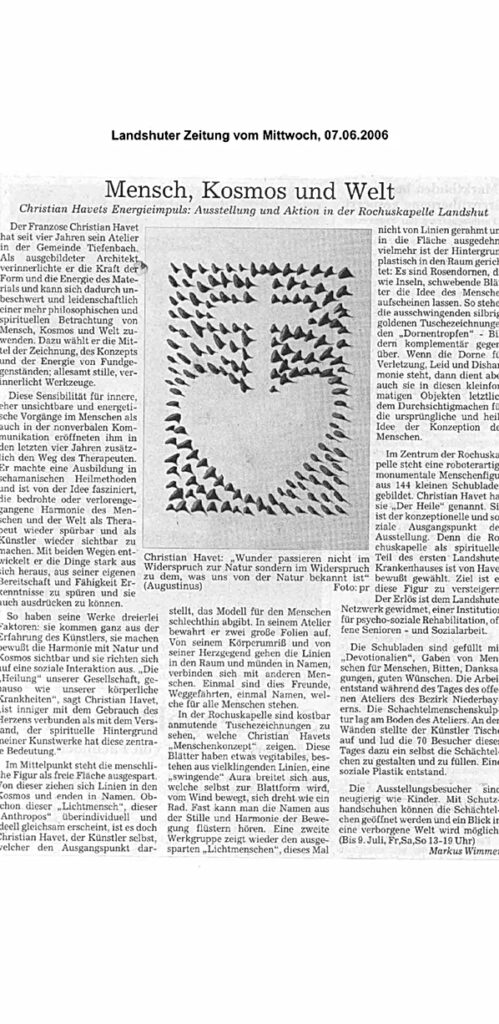
Thus, his works have three factors: they stem entirely from the artist’s experience, they consciously visualize harmony with nature and the cosmos, and they are oriented toward social interaction. « The healing of our society, just like our physical illnesses, » says Christian Havet, is more intimately connected to the use of the heart than to healing; the spiritual background of my artwork has this central significance. » The human figure, a free surface, is at its center. From this, lines extend into the cosmos and end in names. Although this « human being of light, » this « anthroposophy, » appears supra-individual and universal, it is Christian Havet, the artist himself, who represents the starting point, the model for humanity itself. He keeps two large transparencies in his studio. From his body outline and from his heart area, the lines extend into space and end in names, connecting with other people. Sometimes these are friends, companions, sometimes names that stand for all people.
In the Rochus Chapel, precious ink drawings depicting Christian Havet’s « concept of humanity » can be seen. These leaves have a vegetative quality, consisting of multi-resonating lines; a « swinging » aura spreads out, which itself takes on the shape of a leaf, moved by the wind, turning like a wheel. One can almost hear the names whispering from the silence and harmony of the movement. A second group of works again shows the recessed « Light Man, » this time not framed by lines and stretched out into the surface; rather, the background is directed sculpturally into the space, allowing the idea of humanity to emerge. Thus, the swinging, silvery-gold ink drawings complement the « Thorn Drops » images. If the thorn stands for injury, suffering, and disharmony, then in these small-format objects it also ultimately serves to make the original and wholesome idea of the human conception transparent.
At the center of the Rochus Chapel stands a robot-like, monumental human figure formed from 144 small drawers. Christian Havet called it « The Savior. » It is the conceptual and social starting point of the exhibition. Havet deliberately chose the Rochus Chapel as the spiritual part of Landshut’s first hospital. The goal is to auction this figure.
The proceeds will be donated to the Landshut Network, an institution for psychosocial rehabilitation, senior citizen work, and social work.
The drawers are filled with « devotionals, » gifts from people to people, requests, thanks, and good wishes. The workers were present during the Lower Bavaria district’s open studio day. The box-people sculpture lay on the floor of the studio. The artist set up tables along the walls and invited the day’s 70 visitors to design and fill the boxes themselves. A social sculpture was created.
The exhibition visitors are as curious as children. With protective gloves, the boxes can be opened, allowing a glimpse into a hidden world.
(Until July 9, Fri, Sat, Sun 1-7 p.m.)
Markus Wimmer