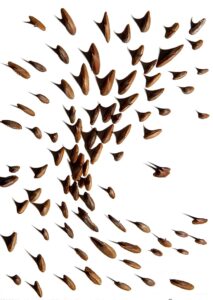
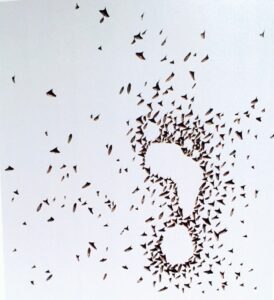
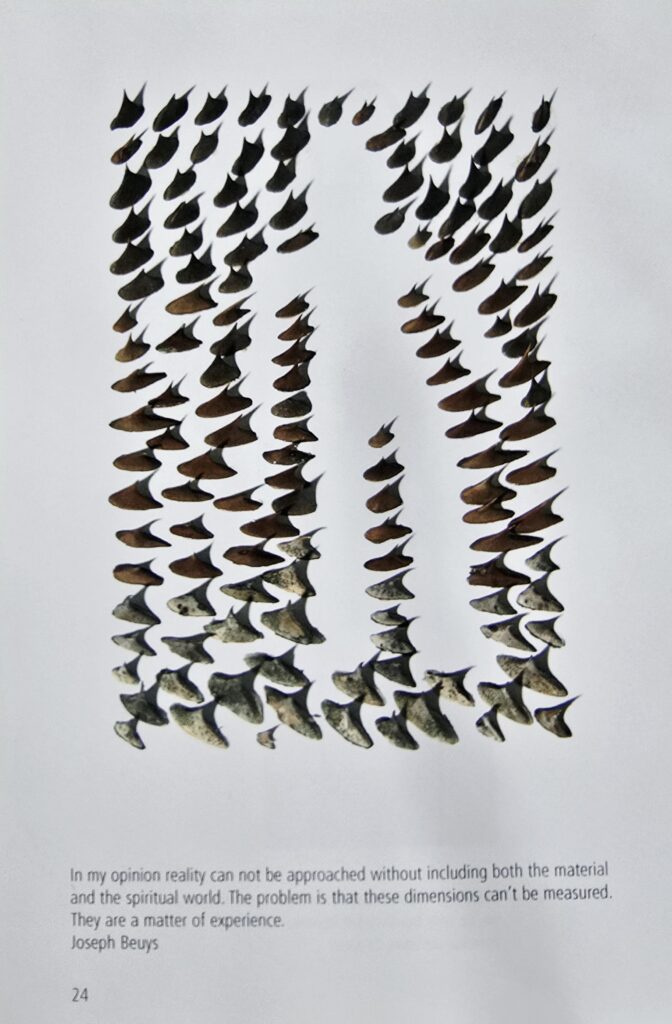
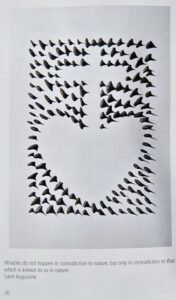
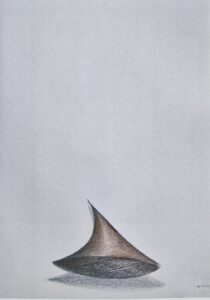
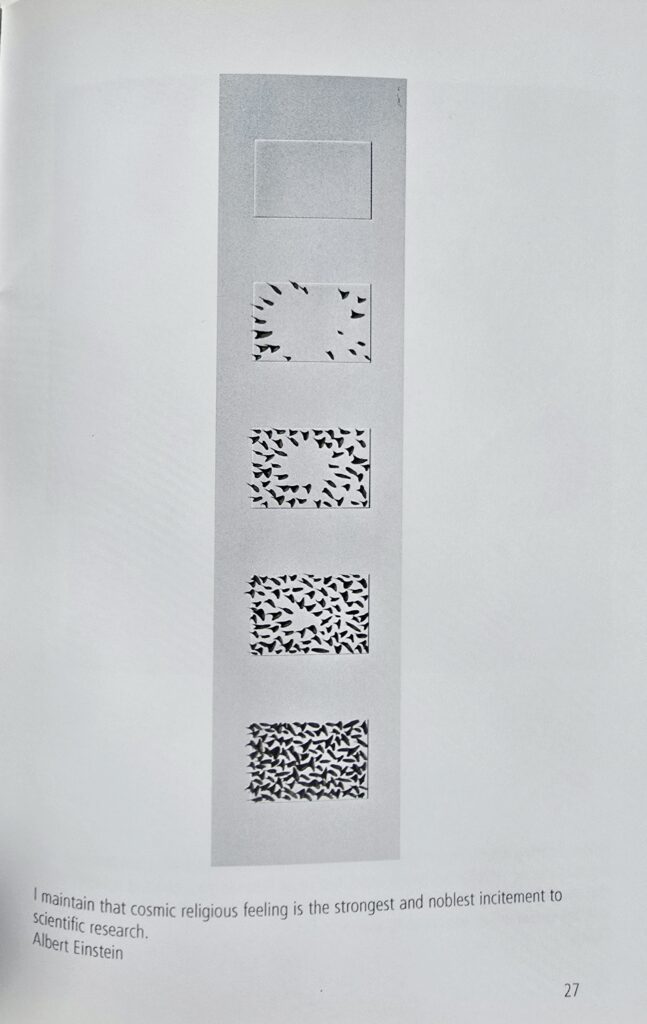
This series of collages originates in my studio Tiefenbach (DE) in a slow, attentive, almost devotional gesture. Garden rose thorns, humble and sharp fragments, are taken, separated from the flower, then placed one by one on a white MDF support. This movement, from the stem towards the space of the work, marks a transmutation: what was protection becomes sign, what hurt becomes language.
The thorn is often seen as a symbol of pain, sacrifice, or trial. Yet it is above all a guardian. She protects the rose, not out of gratuitous violence, but out of fidelity to what is most fragile in her. She affirms a necessary limit so that beauty can remain intact. In this, the thorn is deeply linked to love, not to a naive or complacent love, but to a conscious, incarnated love, capable of saying no to preserve the essential. Unconditional love is not an absence of boundaries. It does not abandon itself indiscriminately. It watches. It surrounds. He protects what is offered. The thorns, here, become the « sentinels » of an invisible centre: they draw forms around a central void, silent and sacred space, which can be read as the heart, the soul, or the place of love itself.
This emptiness is not a lack. It is invisible presence, held breath, mystery. Thorns do not seek to fill it; they reveal it by surrounding it. As in some spiritual traditions, the sacred is never shown frontally: it is approached, circumscribed, respected. The repetition of the gesture, the patient accumulation of elements, evoke a prayer without words, a visual mantra, a meditation embodied in MDF. The white of the support acts as a space of silence, a bare page where each element finds its rightful place. The thorn loses its immediate aggressiveness and turns into a trace, in memory of a living link. On this background, the thorn loses its immediate aggressiveness and turns into a trace, in memory of a living link. What protected the rose becomes an offering to the gaze. What could hurt becomes a path of contemplation.
Through these compositions, a question remains open: how to love without getting lost? How to remain open without engaging in destruction? The answer is not given, but suggested by the form itself. True love does not remove the limit; it makes it conscious. He does not deny the possible pain; he accepts it as the price of presence. Thus, these works offer a vision of unconditional love not as total exhibition, but as a space held, guarded, surrounded by vigilance and gentleness. The thorn does not oppose the rose: it is the silent condition of its blossoming. Similarly, what protects is not always what hurts; sometimes it’s what loves enough to set a limit.
This work is not a break with nature, but a revelation of its deep wisdom: love and protection, beauty and wound, are not opposites, but two sides of the same presence.